|   It is a major safety breakthrough based
on Toyota's experience in advanced automotive technology. SAS concept
includes 3 major functions: It is a major safety breakthrough based
on Toyota's experience in advanced automotive technology. SAS concept
includes 3 major functions:
1. SAS drive function
2. SAS mast function
3. SAS comfort function
This development means Toyota went a step further to tackle the safety
issues highlighted above with a dynamic System of Active Stability.
 1. When does a side tip-over occur ?
A side tip-over happens when the position
of the centre of gravity of the forklift moves sideways, out of the
stability area of the forklift. Typically, this occurs when a forklift
is turning at high speeds, or changing directions.
| |
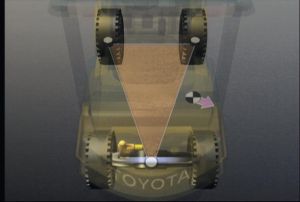 |
In the left picture the centre of gravity
has moved out of the triangle of stability.
|
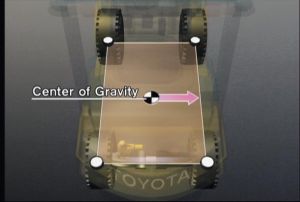
To prevent this Toyota developed a steer
axle locking device as shown on the right picture
|
 |
2. When does a front tip-over occur and when can the lose load on
back tilt happen ?
The balance pivot between the counterweight
and the load is in centre of the front axle. A front tip over will
occur when the position of the centre of gravity of the forklift moves
forward, out of the stability area of the forklift. It happens when
the centre of gravity of the rated load is too far forward.
| |
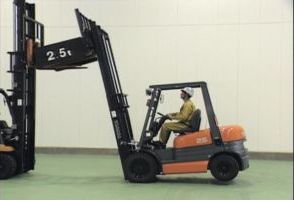 |
The risk of forward tip-over
increases proportionally as the load is raised and the mast
tilted forward (see on the left picture).
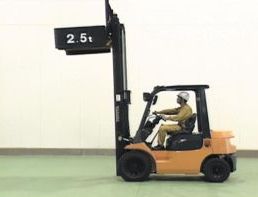
When the truck is carrying a load above 2m, Toyota SAS limits
the forward movement of the mast, therefore preventing accidental
forward tip-over (see picture on the right).
|
Another danger takcled by Toyota SAS
is losing loads when tilting backwards. Toyota SAS automatically
reduces the backward titling speed, avoiding such incidents.
|
 |
3. Concerning the comfort, why using an auto levelling function? and
why an active Steering Synchroniser function ?
To stack or unstack a load it is sometimes
difficult to assess whether the forks are level with the ground or
not. Auto Levelling allows the operator to automatically level his
forks by depressing a button on the tilt lever, allowing him to be
safer in the workplace and more efficient.
Toyota SAS ensures the steering knob always returns to the same position
after a turn (at "8 o'clock" when driving in a straight
line). The stress of the driver is reduced, and he is more efficient
and safe in the workplace.
|
 System of Active Stability